


20.06.2026
June 20, 2026 is the Day of Brick Gothic
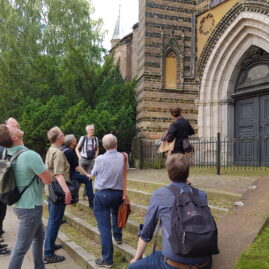
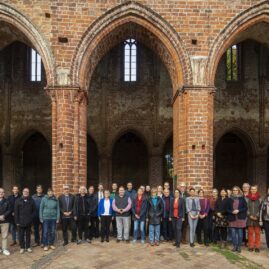
On this day, numerous members of the European Route of Brick Gothic invite the public to enjoy special events, fascinating tours and exclusive insights.
Participating Cities 2026 (the program will be continuously updated)
Barth
10:00 – 11:30 a.m.: Tracing Brick Gothic in Barth
More information at Day of Brick Gothic in Barth
Chełmno
Day of Brick Gothic in Chełmno
Frankfurt (Oder)
10 a.m. to 5 p.m.: Lectures, Talks and Guided Tours
On the occasion of Brick Gothic Day, the Civic Church of St. Mary in Frankfurt (Oder) presents “Over and Gone! Or Not?” – Culture of Remembrance in St. Mary’s”, focusing on historical and contemporary cultures of remembrance and burial.
Look forward to lectures, talks and guided tours about historical burial sites, cemeteries and forms of remembrance in Frankfurt (Oder).
The event focuses on questions of mourning, memory and commemorative culture — then and now, both religious and secular.
Location: Bürgerkirche St.-Marien Frankfurt (Oder), Oberkirchplatz 1, 15230 Frankfurt (Oder)
Free participation including lunch snack
Programme: Gedächtnistag
Registration and tickets (possible until 10 June 2026): Registration
Greifswald
10:00–11:00 Lecture
“Brick Gothic in the Greifswald region: the village church in Levenhagen and its distinctive architectural relationships with St. Nicholas’ parish church in Greifswald”
André Lutze, architectural historian (Market Square, Town Hall, Assembly Hall)
11:00–12:00 Lecture
“The reintroduction of exposed brick construction in the Gothic style in Greifswald in the 19th century”
André Lutze, architectural historian (Market Square, Town Hall, Assembly Hall)
13:00–15:00 Guided tour
“The reintroduction of exposed brick construction in the Gothic style in Greifswald’s Old Town in the 19th century”
André Lutze, architectural historian (Meeting point: Market Square, Town Hall, main entrance)
16:30–18:00 Guided tour
“The reintroduction of exposed brick construction in the Gothic style in Eldena with the founding of the Agricultural Academy in 1835/1836”
André Lutze, architectural historian (Meeting point: Wolgaster Landstraße 39, at the ice cream shop)
Güstrow
From 10:00 a.m.: Brick, History and Very Special Details – A Warm Invitation to a Special Guided Tour in Güstrow Cathedral
On Brick Gothic Day, discover the fascinating world of Brick Gothic architecture, a style that still shapes Northern Europe today. In Güstrow, impressive examples of this architectural style include St. Gertrude’s Chapel, the Church of the Holy Spirit, St. Mary’s Parish Church and, of course, the Cathedral.
During the guided tour, you will learn exciting facts about the origins, architectural features and artistic design of Brick Gothic architecture. With its impressive architecture and rich history, Güstrow Cathedral provides the perfect setting for this experience.
Special attention will be given to selected interior details and to the significance of the cathedral within the regional Brick Gothic tradition.
And best of all: by taking part, you will also be supporting a good cause. All proceeds from admission fees will go toward the restoration of the high altar, helping to preserve this important cultural heritage for future generations.
Registration:
Güstrow Information
Franz-Parr-Platz 10
info@guestrow-tourismus.de
Tel.: 03843 681023
Himmelpfort
The Himmelpfort Brewery will offer a free guided tour of the brewery focusing on Brick Gothic at 13:30.
Meeting point: in front of Himmelpfort Brewery, Klosterstraße 22, 16798 Fürstenberg/Havel.
Kloster Lüne / Lüne Monastery
4:00 p.m.: Bricks in monastery format tell stories
In the second half of the 13th century, a new building material became fashionable: brick. It is produced in series, increases fire protection, and is sustainable. Where was it first used in Lüneburg? In the construction of St. John’s Church in the city, or in the reconstruction of Lüne Monastery after a fire in 1240? You will not find the answer on Wikipedia, but during a guided tour through the monastery on the Day of Brick Gothic of the European Route of Brick Gothic.
Meeting point: In the fountain hall
Guide: Prof. Dr. Edgar Ring
Olsztyn
Day of Brick Gothic in Olsztyn
Płock
“In the Shadow of Brick Walls. The Shared Heritage of Mazovia and Europe” is a project organized by the Płock Local Tourist Organization as part of the Days of Płock History.
June 20, 1:00–5:00 PM
Tour of the Scientific Society of Płock combined with a presentation of early printed books (entry passes required; available at the PLOT office – Pl. Stary Rynek 1, Dom Darmstadt).
June 21, 12:00 PM
Old Market Square (Stary Rynek) in Płock – a walk with guides along the Brick Gothic Route.
The Day of Brick Gothic is part of the Days of Płock History, held that same weekend (June 20–21). This event, celebrating the city’s heritage, will include numerous historical attractions such as demonstrations, workshops, and guided tours. A detailed program will be available closer to the date, typically featuring activities at the Old Market Square and in local museums.
Rostock
11:00 a.m.: Guided Tour on the Theme of Brick Gothic
90-minute guided tour starting at Rostock Information, city centre, Universitätsplatz 6, 18055 Rostock
Price: €15 per adult aged 15 and over, €13 with guest card, €6 for children up to 14 years old and for persons with severe disabilities
Stendal
2:00 PM to 4:00 PM: Special guided tour “Traces of the Romanesque predecessor buildings in the Gothic churches (St. Petri and St. Nicholas Cathedral) and the Tangermünde Gate”
Starting from the market square, the historic market ensemble will be explored. The focus lies on the beginnings of brick construction and its spread throughout the region. From here, visitors gain a first view of examples of Brick Gothic architecture. The market ensemble itself will be examined in more detail. The city guide will explain the building material brick: when brick construction first emerged and when the know-how reached the region. The tour then continues through the streets of the old town to St. Petri Church. There, participants will search for traces of the Romanesque predecessor building and learn about the special features of the church’s architectural history. A short visit inside the church offers a closer look. A walk along the ramparts leads to St. Nicholas Cathedral. Along the way, the guide explains what the fortifications looked like in the 14th and 15th centuries and when they were redesigned. The western structure of St. Nicholas Cathedral also reveals traces of the Romanesque predecessor building. The search for these traces then continues in the inner courtyard. The route proceeds along the ramparts to the Powder Tower and finally to the Tangermünde Gate, where both architectural styles can again be clearly recognized. Climbing the Tangermünde Gate forms the worthy conclusion of the tour.
Meeting point: Roland Market Square, Markt 1, 39576 Hanseatic City of Stendal
The guided tour is free of charge.
2:00 PM to 5:00 PM: Free guided tours at the former Gertrauden Hospital
The association Förderverein Gertraudenhospital Stendal (Scharnhorststraße 2, near the Uenglingen Gate) also offers a program for the Day of Brick Gothic Architecture. From 2:00 PM to 5:00 PM, free guided tours will be available. Visitors are also invited to enjoy coffee and cake while talking with members of the association.
General Information about the Day of Brick Gothic
The special day declared by the European Route of Brick Gothic is held throughout Europe every year on the third Saturday in June and raises awareness of the cultural heritage of Brick Gothic.
The occasion for the first Day of Brick Gothic in 2018 was the European Year of Cultural Heritage, which was celebrated across Europe with the idea of “Sharing Heritage”. In Germany, Denmark and Poland, the Day of Brick Gothic is realised through the combined effort of representatives of monument preservation, science, the Church, tourism and administration and is coordinated by the European Route of Brick Gothic.
The member cities of the European Route of Brick Gothic combine the shared cultural heritage of Brick Gothic – the Medieval Brick Gothic architecture predominantly in the Baltic Sea region, which they aim to convey together to the general public. An important shared goal is to inspire people for conserving this cultural heritage.