


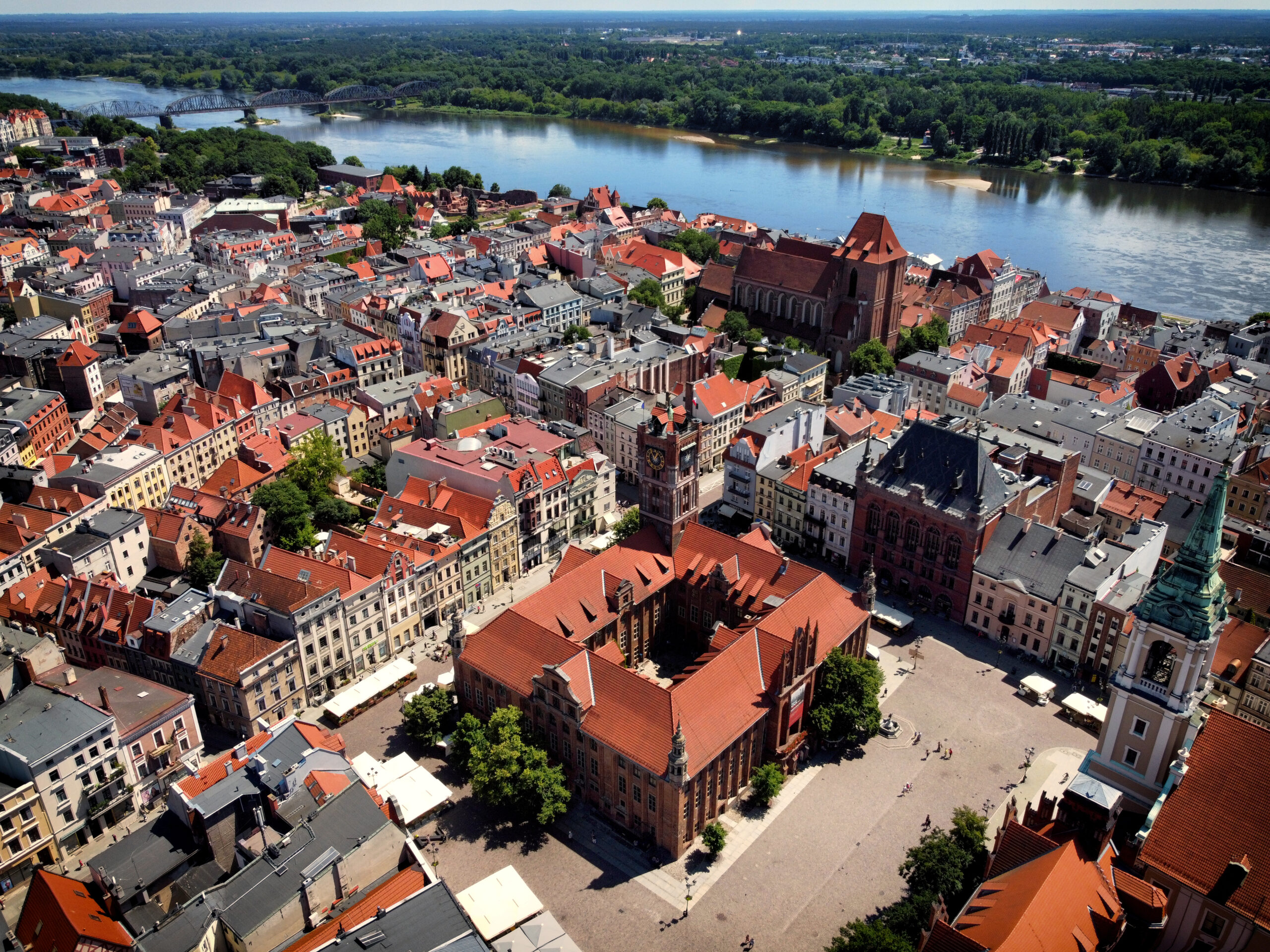
TORUŃ – BRICK GOTHIC YOU CAN TOUCH
In the birthplace of Nicolaus Copernicus, there is – after Kraków – the largest number of authentic Gothic art and architectural monuments in Poland. Alongside the Copernican tradition and the legendary gingerbread, Toruń’s Brick Gothic architecture is the most important asset of the historic city.
Gothic and UNESCO
The Brick Gothic gem of Toruń is the Old Town Hall – the greatest adornment of the Old Town Market. It is officially recognized – alongside the three Gothic churches of Toruń – as a masterpiece of human creative genius. The building has been rebuilt many times, in such a way that it contains a year-round calendar: one tower symbolizes the year, four corner turrets represent the four seasons, 12 large halls correspond to the 12 months of the year, 52 smaller rooms match the number of weeks in a year, and the building had 365 windows, each representing a day of the year.
The city has avoided total destruction throughout its turbulent history. The street layout, established in the Middle Ages with the main promenade ul. Szeroka, the unprecedented number of centuries-old monuments, and the atmosphere created – especially from April to September – by crowds of tourists from all over Poland and abroad make the city extraordinary. The historical significance of Toruń’s Old Town led to the city being included as one of only a few places in Poland on the UNESCO World Heritage List.
The City of Copernicus
Toruń is a tourist city, most popular with young people. Their main interest lies in the tradition associated with Nicolaus Copernicus, who was born in Toruń in 1473. They visit the family home of the great astronomer, which now operates as a museum dedicated to him. They also enter the Toruń Cathedral, built during the Teutonic era, which houses, among other things, a medieval baptismal font (where Copernicus was named) and Poland’s largest medieval bell, Tuba Dei (“God’s Trumpet,” 1500).
Visitors typically also go to the Toruń Planetarium – the most modern and technologically advanced in Poland – located in the Old Town in a historic gas lighting reservoir. Here they can attend one of dozens of astronomy shows.
Worth Knowing:
- Toruń was founded in the Middle Ages by the Teutonic Knights (city charter granted in 1233).
- Toruń is one of the seven historical centers of Poland.
- The medieval buildings of Toruń represent the finest achievements of Gothic brick architecture in Europe.
- The preserved residential houses in Toruń form the largest and best-preserved complex of Gothic residential architecture in Northern Europe.
- In the Middle Ages, Toruń belonged to the Hanseatic League – a commercial alliance of European cities. The Vistula port in Toruń enabled connections between Poland and all of Northern Europe.
- In 1501, the Polish king John I Albert died in the Toruń Town Hall.
- In 1645, the Colloquium Charitativum took place in Toruń – a theological debate famous throughout Europe among Catholic, Lutheran, and Calvinist theologians.
- In St. James’ Church is the mystical crucifix Tree of Life – a unique sculpture on a European scale and the most outstanding work among 14th-century crucifixes from Toruń workshops.
- A notable feature of the Church of the Assumption of the Virgin Mary is the tomb of Anna Vasa, who died in 1625 – daughter of the Swedish king John III Vasa and his wife Catherine, sister of the Polish king Sigismund Vasa (due to her Protestant faith, she could not be buried in Wawel, Kraków).
- Toruń has a double-ring fortification system built by the Prussians – a monument of 19th-century defensive architecture.
- Toruń is home to the Nicolaus Copernicus University – one of the best universities in Poland and the largest higher education institution in northern Poland (42,000 students).