

Monastery of Himmelpfort
Around 1299, the Lehnin Monastery sent monks to what is now the Himmelpfort region so that they might found a new monastery there. They found lakes and forests, and upon their arrival the Cistercian monks exclaimed, “Coeli Porta, this is the gate to heaven – here we shall settle”.
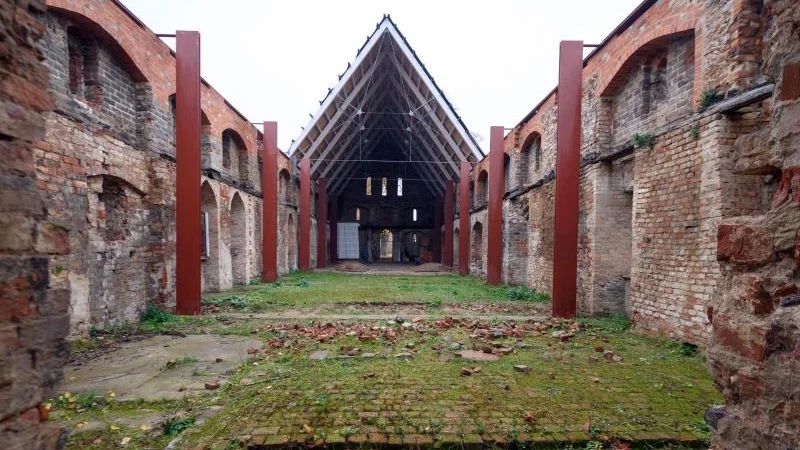
The former monastery buildings in Himmelpfort have suffered much destruction over the centuries, so unfortunately not much of the original complex has been preserved. Only parts of the former monastery church – which was later repurposed as a village church and is now partly a ruin – as well as sections of the former surrounding wall remain. However, the monks’ former economic building, once a sacred site, has also survived. Here, diligent work, trade, and production took place. Without dependents, and relying on the monastery’s holdings, the monks sought to sustain themselves in this place.
As part of the archaeological investigations after 2016, it was proven that beer was brewed here extensively (“Liquida non frangunt ieunum” – liquids do not break the fast). For the monks, this strongly spiced and low-calorie beverage, called beer, served as a fasting food. It contained significantly less alcohol than today and had a filling effect. This drink, brewed with grut – a mostly regionally typical mixture of herbs – was only made during the cooler months, as there was no way to cool it in summer. For this reason, the term “brewery” became established in everyday language.
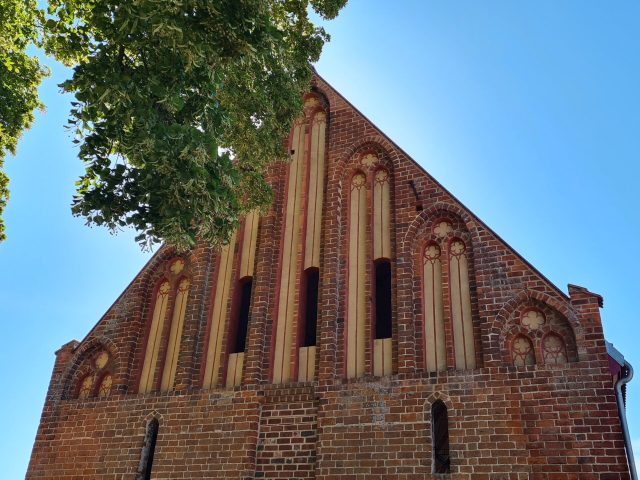
The 40 m × 10 m building features a rare Gothic decorative gable, which was unknown until the reconstruction of the brewery in Himmelpfort. The painting on this gable carries strong symbolism. In the Middle Ages, reading and writing were far from accessible to all social classes, so imagery was used as a way to communicate with the broader population. In its symbolism, we see references to the omnipotence of God, the two tablets of the Ten Commandments received by Moses from God, the four Evangelists who recount their experiences with Jesus from their perspective, and indications of dualities in human life. The building was constructed around 1430 and originally served as a kitchen, with a sleeping area for the monks above.
Despite plundering and destruction, the building remained largely intact in its basic structure. In 1910 it was converted for residential use, and in 2010 it was destroyed down to the foundations in a severe arson attack. In 2024, just in time for the 725th anniversary, the reconstruction of the building was celebrated by the non-profit Bürgerstiftung Himmelpfort. The construction work lasted nearly 10 years and was carried out in close coordination with the Brandenburg heritage authorities. The result is an appealing architectural blend of classical and modern elements.
Since then, it has been used as an event venue and is always worth a visit, especially during the Christmas season, as Santa Claus resides in the building directly opposite at that time. Himmelpfort has its own Christmas post office, and every year around 300,000 wish letters from all over the world arrive here and are answered.